

Recovery is rarely a straight highway. More often, it resembles a steep trail cut across uneven terrain, marked by sudden switchbacks, plateaued stretches of fatigue, and occasional clearings where the view makes every single stumble worthwhile.
Whether healing from substance dependence, navigating the fog of mental burnout, mending a shattered relationship, or reclaiming physical vitality after illness, words hold weight. When mental reserves run low, a concise, resonant phrase acts as an anchor. It cuts through spiral thinking, grounds the nervous system, and points toward the next right action.
Below is an expansive, carefully categorized collection of over 100 original reflections, time-tested wisdom, and restorative mantras designed to support every stage of healing.
The Architecture of Recovery: Key Historical Voices
Before exploring the words themselves, it helps to understand the pioneers, thinkers, and advocates whose work laid the groundwork for modern recovery movements.
Key Pioneers in Healing, Psychiatry, and Addiction Recovery
| Pioneer / Figure | Era / Years Active | Field / Discipline | Core Contribution / Focus | Known Philosophy |
| Bill Wilson & Dr. Bob Smith | 1935–1971 | Mutual-Aid Support | Co-founders of Alcoholics Anonymous (AA) | The 12-Step framework; mutual peer accountability |
| Dr. Carl Jung | 1900–1961 | Analytical Psychology | Archetypes, shadow integration, and spiritual transformation | Healing requires facing and integrating the inner shadow |
| Viktor Frankl | 1940s–1997 | Neurology, Psychiatry & Logotherapy | Author of Man’s Search for Meaning; existential analysis | Freedom lies in choosing one’s attitude in any circumstance |
| Dr. Gabor Maté | 1990s–Present | General Practice, Trauma & Addictions | Author of In the Realm of Hungry Ghosts; compassionate inquiry | Addiction originates in emotional pain, not moral weakness |
| Dr. Bessel van der Kolk | 1970s–Present | Neuropsychiatry & Trauma Research | Author of The Body Keeps the Score; somatic processing | Trauma reshapes brain and body; recovery requires somatic safety |
| Brené Brown | 2000s–Present | Social Work & Qualitative Research | Research on shame resilience, vulnerability, and courage | Vulnerability is the birthplace of connection and wholehearted living |
Grounding Mantras for the First 24 Hours
The start of any major reset brings physical unease and overwhelming thoughts. In this stage, abstract philosophies fall flat; survival depends on tiny units of time.
Anchors for the Immediate Moment
- The urge is a wave: it rises, crests, and breaks. You do not have to fight the water; you only have to stand your ground until it ebbs.
- Win the morning, protect the afternoon, endure the evening. Tomorrow belongs to tomorrow.
- Discomfort is not danger; it is the feeling of old habits unraveling.
- When you cannot see the finish line, look down at your shoes and take the single step in front of you.
- Your body is renegotiating its terms with reality. Give it patience, water, and rest.
- A craving lasts minutes; the regret of surrendering to it lasts days.
- Say no right now. You can decide about later when later arrives.
- Silence the noise of your entire future; win this specific hour.
- You do not need to feel confident to be clean and safe today; you only need to be willing.
- Breath in calm, exhale panic. Your pulse will slow; your mind will follow.
Overcoming Relapse, Stumbles, and Shame
Setbacks frequently trigger an “all-or-nothing” mental trap, convincing people that a single slip erases all prior progress. Healing requires dismantling this misconception.
Reframing Setbacks and Protecting Progress
- A stumble is an event, not an identity. A compass needle wiggles before pointing true north again.
- Relapse begins in secrecy long before it shows up in action. Bring the truth into the light immediately.
- You did not lose the days, weeks, or months of clarity you built; the lessons remain etched in your brain and body.
- Guilt asks, What did I do? Shame insists, Who am I? Answer guilt with correction, and dismiss shame outright.
- The road does not vanish because you stepped into the ditch. Turn around, plant your boots on the asphalt, and keep walking.
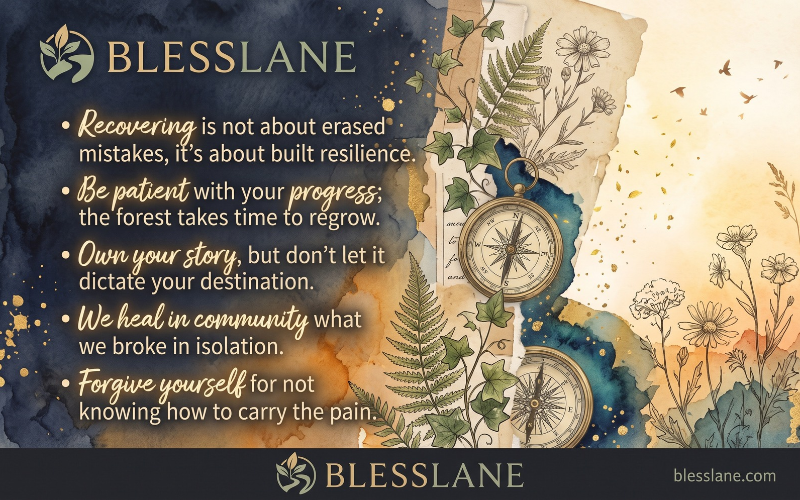
- Forgive yourself for not knowing how to carry pain without dropping it. Now pick up the tools and adjust your grip.
- Rock bottom is simply the place where the digging stops and the foundation begins.
- Do not turn a temporary slip into an extended detour. The exit ramp is open right now.
- Compassion toward yourself is not an excuse for poor choices; it is the soil from which genuine accountability grows.
- Your history explains your habits, but your choices dictate your trajectory.
Cultivating Daily Resilience and Emotional Sobriety
Physical abstinence or the cessation of a toxic habit is merely stage one. Emotional sobriety—learning to handle anger, boredom, grief, and joy without escaping—is the real long-term work.
Staying Steady in the Monotony of Routine
- Sobriety is what you avoid; recovery is what you create to replace it.
- The most dangerous emotion in early stability is not despair, but boredom. Fill the void with purpose before old patterns fill it for you.
- Peace is not the absence of chaos; it is the quiet confidence that you no longer need an artificial shield to survive it.
- Healing happens in the ordinary repetitions: making the bed, cooking a meal, speaking honestly, and sleeping without regret.
- You are allowed to outgrow people, rooms, and conversations that require you to stay small or numb to participate.
- Resentment is poison you swallow while waiting for another person to get sick. Pour out the vial.
- Boundaries are the fences that keep your newly planted garden from being trampled by casual visitors.
- When old fears knock on the door, send your current self-worth to answer.
- A quiet evening with a clear mind is not wasted time; it is a hard-won victory.
- The hardest conversations you will ever have are the ones where you look into the mirror and demand honest answers.
Courage, Vulnerability, and Breaking Isolation
Addiction, depression, and trauma thrive behind closed doors. Recovery begins the moment isolation is replaced with genuine connection.
Reaching Across the Divide
- We heal in community what we broke in isolation. Let someone witness your struggle.
- Asking for help is not an admission of defeat; it is a declaration that you refuse to stay trapped.
- The truth might feel heavy when you say it out loud, but secrecy will rot you from the inside out.
- Real strength is not stoic silence; it is the courage to admit when your hands are shaking.
- Find people who celebrate your sober milestones with the same intensity with which the world offers temptations.
- You do not have to carry the whole weight alone; shared grief is cut in half, while shared hope is doubled.
- Vulnerability without boundaries is reckless, but boundaries without vulnerability create a prison. Strike the balance.
- When you tell your story without shame, you give other people permission to put down their own masks.
- Drop the armor. It protected you during the war, but it prevents you from feeling warmth in peacetime.
- Trust is rebuilt in pennies and spent in dollars. Keep depositing small, honest actions every day.
Physical Healing, Mental Health, and Somatic Balance
Healing is not purely a mental calculation; the nervous system keeps an exact inventory of stress, trauma, and exhaustion.
Restoring the Mind-Body Link
- Treat your nervous system like an exhausted child: regulate the environment, lower the lights, hydrate, and provide safety.
- Exercise is not a punishment for what you consumed; it is a celebration of what your lungs and muscles can do when unclogged.
- Sleep is medicine. Rest is an active component of your recovery strategy, not a luxury prize you earn after breaking down.
- Notice where tension sits in your shoulders and jaw. Exhale and drop them. Safety begins physically.
- Nourish your brain with food that supports clarity, not substances that induce temporary euphoria followed by biological debt.
- When emotions peak, pause your mind and consult your body. Are you hungry, angry, lonely, or tired? Address the physical need first.
- Sunlight, clean air, and cold water remind the biology of its innate vitality.
- Movement purges stagnant anxiety faster than endless rumination ever will.
- Honor the fatigue. Rebuilding internal organs, neurotransmitters, and neural pathways requires massive metabolic energy.
- You cannot think your way out of a nervous system dysregulation; you must breathe, ground, and soothe your way back to stability.

Self-Compassion, Identity, and Healing Childhood Wounds
Many destructive behaviors are clumsy attempts to soothe unhealed wounds from younger years. Recovery involves becoming the protective, understanding guardian you needed long ago.
Making Peace with the Past
- Stop expecting a wounded version of yourself to perform like an uninjured champion. Give your past self grace.
- The coping mechanisms that once kept you safe as a child are the very habits suffocating you as an adult. Thank them for their service, then retire them.
- You are not fundamentally defective; you are an adaptable organism that developed extreme strategies to survive extreme environments.
- Talk to yourself the way you would speak to a friend who is fighting for their life.
- Self-worth is not derived from a clean resume; it is realized by recognizing your inherent value as a living being.
- You do not have to love every flaw, but you must stop treating your natural human limitations like unforgivable crimes.
- Healing is peeling off the labels that panicked, hurt people slapped onto your back when you were too young to defend yourself.
- When your internal critic starts shouting, ask who taught it those exact words.
- You cannot shame yourself into lasting change; lasting transformation only sticks when rooted in self-respect.
- Your scars tell a story of impact, survival, and cellular regeneration. They are evidence of endurance, not failure.
Rebuilding Trust, Relationships, and Family Dynamics
One of the steepest hills in recovery is realizing that while your commitment to change may happen overnight, the healing of trust in loved ones takes sustained time.
Navigating Amends and Restored Bonds
- An apology without altered behavior is just sophisticated manipulation. Let your actions do the talking.
- Allow loved ones to feel their anger and caution. Their skepticism is a rational response to past patterns.
- You cannot rush someone else’s timetable for trusting you again. Keep showing up reliably and let time do the repair work.
- True amends involve stepping out of the spotlight and listening to how your choices impacted the surrounding room.
- Not every burned bridge needs to be rebuilt. Some crossings should remain closed to protect your peace.
- Consistency is the only currency that buys back lost credibility.
- Love them enough to respect their boundaries, even when those boundaries sting your ego.
- Stop defending your past mistakes; invest that defensive energy into protecting your current progress.
- Healthy relationships thrive on mutual clarity, mutual freedom, and shared honesty. If drama is required, it is not love.
- Forgive those who cannot understand your path; they are viewing your transformation through the lens of who you used to be.
Short, Impactful Daily Affirmations
When cognitive overload strikes, lengthy wisdom can feel too heavy to process. These concise lines work well as morning reminders, phone lock screens, or post-it notes on a bathroom mirror.
Pocket Reminders for Quick Reset
- Clear eyes, steady hands, honest heart.
- Progress over perfection, every single day.
- Feelings are data, not instructions.
- Choose the discomfort of discipline over the agony of regret.
- One day at a time, one decision at a time.
- Protect your peace like your life depends on it—because it does.
- The urge will pass; your integrity will remain.
- Stronger than the impulse, calmer than the storm.
- Do the next right thing, however small.
- Freedom lives on the other side of honesty.
- Breathe deep. You are here. You are safe.
- Break the cycle today.
- Keep your feet planted where your body is.
- Quiet mind, steady purpose.
- Hope is a muscle; flex it daily.
Long-Term Growth, Purpose, and Rediscovering Joy
Recovery is not an endless funeral for your past lifestyle; it is an awakening to genuine engagement, curiosity, and vitality.
Thriving in the Second Chapter
- The ultimate reward of healing is not merely surviving without a crutch; it is waking up excited for an ordinary Tuesday.
- You spent years becoming an expert in surviving misery. Now redirect that incredible stamina toward building something magnificent.
- Genuine joy in sobriety arrives without a hangover, an empty wallet, or a morning spent checking sent messages in panic.
- When you clear away the debris of an old coping mechanism, you discover passions that were buried beneath the wreckage.
- Service to others is the greatest insurance policy against sliding back into self-absorbed traps.
- Look back at the past year not to relive the pain, but to marvel at the distance you have covered.
- Real freedom is having nothing to hide, nothing to prove, and nobody to run from.
- Your past pain can become the roadmap that guides someone else out of the same dark woods.
- Live in such a clear, intentional way that nobody in your future ever doubts your character.
- Gratitude is the filter that transforms what you currently have into more than enough.
- You were not broken beyond repair; you were a masterpiece undergoing a radical, painful restoration.
- Celebrate the quiet milestones: laughing until your stomach hurts without any chemicals in your bloodstream.
- The world needs the clarity, empathy, and raw truth of people who have walked through the fire and chosen life on the other side.
- Do not settle for just staying clean or surviving; build an existence so rich and grounded that going backward sounds absurd.
- The journey does not end when the darkness clears; that is simply where the real adventure begins.
- You survived the worst moments of your life; now give yourself permission to enjoy the best of them.
The Neurobiology of Hope: Why Words Help Recalibrate the Brain
When a person experiences intense stress, trauma triggers, or physical withdrawal, the rational prefrontal cortex—the part of the brain responsible for executive decision-making, long-term planning, and impulse control—tends to get hijacked by the amygdala. The amygdala functions as the brain’s smoke detector, driving fight, flight, freeze, or fawn responses.
[Trigger / Craving / High Stress]
│
▼
[Amygdala Alarm Activated]
(Heart rate climbs, tunnel vision, fight/flight urge)
│
▼
[Cognitive Pause & Grounding Mantra]
(e.g., “Feelings are data, not instructions”)
│
▼
[Prefrontal Cortex Re-engaged] ──► [Constructive Choice Made]
Reading, reciting, or writing down grounding reflections interrupts this automatic cycle through three concrete physiological mechanisms:
- Linguistic Labeling (Affect Labeling): Putting complex emotional states into structured words reduces activity in the amygdala and restores executive processing.
- Cognitive Reframing: Mantras provide an alternate interpretation of discomfort, transforming feelings of panic (“I can’t survive this”) into manageable resilience (“This is discomfort, not danger”).
- Vagal Regulation: Pairing rhythmic reading or verbal repetition with deep diaphragmatic breathing stimulates the vagus nerve, lowering heart rate and downshifting the sympathetic nervous system.
Frequently Asked Questions About Using Words in Recovery
How can reading quotes actually assist during a serious craving or mental spiral?
Quotes act as a pattern interrupt. During a craving or anxiety spike, your mind runs on high-speed loops driven by primitive, emotional structures. Engaging with a grounding sentence forces cognitive processing, slowing the emotional surge and giving the prefrontal cortex time to reassert control.
Where should I place these reminders to make them most effective?
Visibility is everything. Place them where your eyes naturally land during moments of vulnerability:
- Set a favorite mantra as your smartphone lock screen.
- Stick an index card onto the bathroom mirror or car steering wheel.
- Keep a pocket notebook with your top three grounding phrases.
- Write one at the top of your daily planner or work calendar.
What should I do if positive reflections make me feel cynical or angry?
Cynicism is often a defense mechanism designed to protect you from the pain of disappointment. When uplifting words feel false, avoid overly cheerful affirmations. Instead, lean into realistic, stoic, or pragmatic truths, such as: “Discomfort is not danger,” or “I only have to get through today.” Ground yourself in reality rather than forced positivity.
Can language alone cure addiction, clinical depression, or trauma?
No. Words and mantras are supportive tools, not comprehensive medical or psychological treatments. Sustainable long-term recovery generally requires a multi-pronged approach that includes professional therapy, medical supervision when dealing with physical dependencies, supportive peer communities, lifestyle adjustments, and consistent habit restructuring. Use these reflections as day-to-day anchors alongside professional care.
Related Posts
- 80+ Sunday Inspirational Quotes to Recharge Your Mind
- 80+ Saturday Inspirational Quotes to Fuel Rest, Joy, and Purpose
- 80+ Friday Inspirational Quotes to Finish Your Week and Welcome the Weekend
- 80+ Thursday Inspirational Quotes to Finish Your Week Strong
Conclusion
Recovery is not an instantaneous transformation; it is an ongoing series of small, intentional choices made minute by minute, day after day. In the quiet moments when doubt creeps in or old habits call, the right words can serve as an indispensable lifeline, pulling you back from the edge and centering your focus on what truly matters: the present step.
Every individual path through healing will encounter rough terrain, unexpected turns, and moments of heavy fatigue. Yet each hurdle cleared is undeniable proof of your resilience and capacity for reinvention. The struggles of your past do not define the boundaries of your future; they simply mark the starting point from which your strength was forged.
Carry these reminders with you as personal armor against despair and complacency alike. Protect your progress with patience, surround yourself with honesty and support, and never underestimate the quiet courage it takes to choose renewal over retreat. Your story is actively being rewritten, and the best chapters are still waiting to be lived.